Since I wrote EMDR Made Simple: Four Approaches for Using EMDR with Every Client (Premier Publishing & Media, 2011), I’ve been fascinated by comparing the dynamics that we see in religion with the dynamics that we see in psychology, especially as approaches to therapy develop. A well-known quote of mine from that book, which several sources have “memed,” declares:
Debate in psychotherapeutic professions can sometimes be reminiscent of that in religious circles. Each school of thought has the potential to think that its way is the “best way” to help people, and within each school of thought, like within each religious group or denomination, you have people with different degrees of rigidity or fundamentalism to their trends.
Coming into the EMDR Therapy community shortly after my own deconstruction from growing up and going to graduate school in two high demand religions really got the wheels in my head turning about these comparisons, and they served as the basis for the “Four Faces of EMDR” Model introduced in EMDR Made Simple. Now that I’ve finished seminary studies in Interfaith ministry, my theological nerdiness is in overdrive and I’m seeing even more places where we can draw some salient comparisons.
Throughout my studies at the Chaplaincy Institute, my professors emphasized the importance of knowing how to read scripture, generally defined as any sacred or revered text. In the modern world we can see the peril of what happens when a sacred text of any religion, like the Bible in Christianity, can be read and interpreted through various lenses. Some readers see a loving God, others see a vengeful and judgmental God. And Catholics and Protestants can’t even agree on what constitutes “the Bible” (i.e., Catholics have 73 books, Protestants only 66, and then you can add the Ethiopian Orthodox Bible to the mix, who cite 81-88 books depending on context).
When I formally learned about the six primary methods that theologians and scholars can use to read and interpret scripture, my first reaction was, “This sounds like the EMDR community!” People read the Shapiro texts and teachings based on their worldview and they see what they want to see in them unless they deliberately make an effort to put on another lens and attempt to see things through another light. As I present the summary of each from a theological perspective, think of the comparison that you can make to the reading of any psychology text, specifically Shapiro’s core text EMDR Therapy: Basic Principles, Protocols, and Procedures (3rd edition, 2018):
- Literal reading of the scripture: taking exactly what it says at face value
- Allegorical reading of the scripture: metaphor and story present the essence of the meaning, yet even that can be mined and interpreted
- Moral reading of the scripture: a very law-and-order reading of the text to give us order in practice and daily life
- Anagogical reading of the scripture: focuses on how we end our suffering, often seen as the most mystical or supernatural focus
- Historical-contextual reading of the scripture: emphasizes the importance of knowing who the scripture was originally written for and the context in which it was written before making assumptions on how it applies to readers in a present time
- Devotional reading of the scripture: the most subjective method which implies that what you personally draw from reading the scripture is what you are intended to draw from it
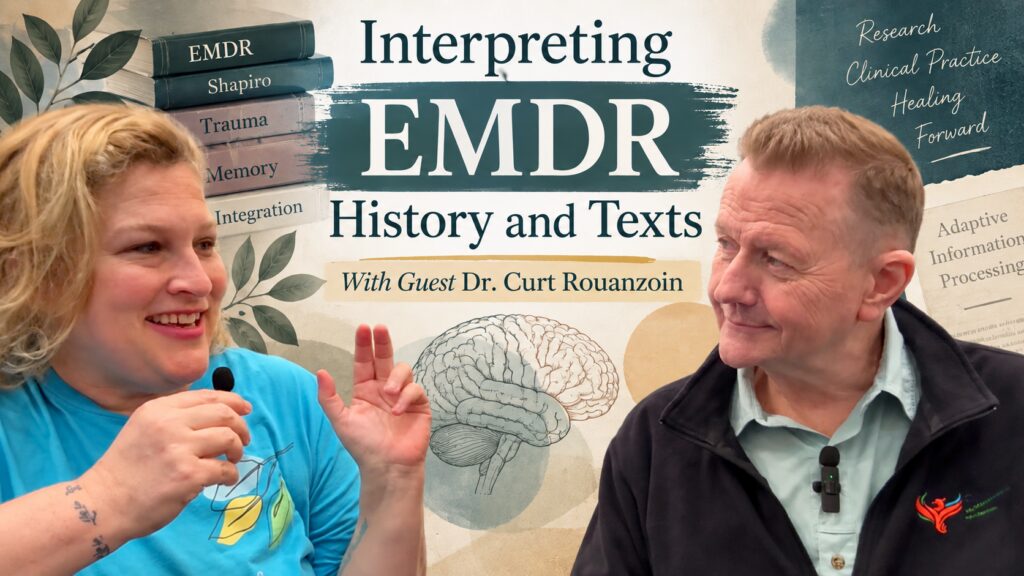
In this special interview, I chat with my long-time friend and mentor in the EMDR Therapy community, Dr. Curt Rouanzoin, who also has a background in biblical studies. We discuss how taking a historical-contextual approach to understanding the work of Shapiro as modern EMDR practitioners is important. Since Curt was trained in EMDR Therapy in 1992 and worked closely with Dr. Shapiro herself, he sheds light on some of the necessary historical context that those of us trained in later years will need to consider before drawing too many conclusions. And he brings this historical-contextual information in with a sensitivity to nuance and prioritizing relational elements in EMDR Therapy.
I hope that you enjoy listening to and learning from this interview as much as I enjoyed conducting it. And CONGRATULATIONS to Dr. Rouanzoin on winning the 2026 Francine Shapiro Award from the EMDR International Association!
To learn more about Dr. Rouanzoin and his training company EMDR, please visit: