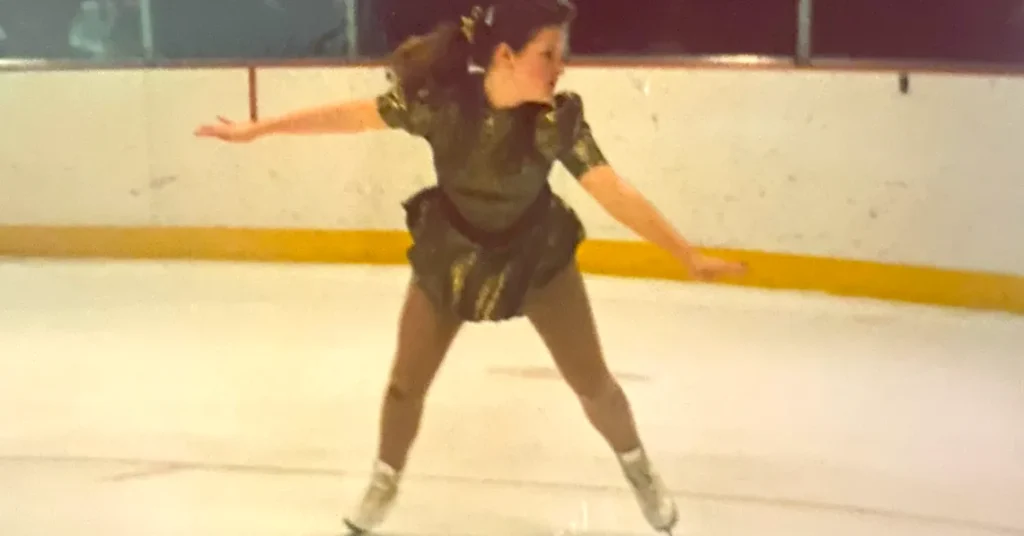
Figure skating was my first real passion. Even though my clumsy body and neurodivergent way of being kept me from ever having a chance to be great at the sport (plus we lived an hour away from an indoor rink), I was that kid who tried. I loved the smell of ice. There was something about it that calmed my nervous system and soothed my tendency to overheat. I fancied ice dancing, learning the ballroom patterns on skates, better than jumping or spinning.
Ever since I was a child, I’ve been a superfan. If YouTube or Jackie Wong, the most trusted name in figure skating, was around when I was a kid, I might never have finished school, so consumed would I have been with getting all that great skating input from all over the world! I remember calling The Youngstown Vindicator during the 1994 Olympics in Norway to have them read me the Associated Press feed of the results because the skatingsphere online was not yet a thing. As I attend my first ever Winter Olympic Games in-person this week in Milan, Italy, I’ve been getting nostalgic about the impact that skating has made on my life.
Leading up to the Games, it was a joy to hear Jackie Wong interview Sandra Bezic, a Croatian-Canadian pairs skater, choreographer, and commentator from my youth about the state of figure skating as a sport and its judging system. If you were born after 2000 and have tried to watch figure skating casually, you may be scratching your head trying to figure out how, exactly, figure skating is scored with its base values, levels, grades of executions, technical scores, and program components. I’ve learned the system reasonably well and can still get confused. If you are in your forties like me or older, you may remember the simplicity of the old 6.0 system and wonder whatever happened to that. Even in that system, you may have asked why a 6.0 was perfect instead of a 10? I am not going to infodump about judging, but I want to give you enough context to appreciate this piece and why it matters to the point I’m about to make comparing skating and my actual profession. There are plenty of good documentaries like Meddling and an episode of Bad Sport that you can watch about the judging controversy at the 2002 Olympics that caused the need for an overhaul.
While reform needed to happen, Sandra Bezic hit the right edge when she said during her interview, “We are focusing on the wrong things.” Instead of weeding out the corrupt judges or addressing the shadiness that happens whenever fallible, politicking humans enter the arena of judged sport, the powers that be have tried to make the judging system ever more complex in an attempt to combat the political machinations. There are some in our sport who say that now having every second of a program judged for content enhances its credibility as a sport in a larger society where the general public can still look down on “judged sports” as not being real sports. Yet most of us seem to have some variation of the opinion that the new era of the International Judging System has also killed creativity and artistry in the process.
Bezic said in her interview, “Of course we need rules, we need parameters. But it needs to breathe.”
When I heard her wisdom I let out a “Hallelujah” not just as a skating fan, but as an educator of clinical professionals.
In my online blogging activities, I’ve taken on what I see as the problems in the fields of the clinical helping professions and how we educate others. My largest piece on the matter, Continuing Miseducation, is a good companion to read alongside this piece. Like Bezic commented, I believe that we need a modicum of rules and standards in how we educate therapists, social workers, family therapists, addiction counselors, and psychologists both at the graduate level and in post-graduate continuing education. My fear is that in our community’s attempts to raise the standards by putting in more rules to follow and boxes to tick, we’ve actually killed quality, especially in continuing education. The reason is exactly what Bezic identified—we’ve taken out the room to breathe. In clinical education, that means being able to leave some of the time on the teaching schedule unplanned to address the unique needs and learning questions that are coming up for the particular cohort of students with which you are working. That means leaving room for the educators and their assistants to share their real-life stories from the field about how teaching the concepts that we are teaching translate into clinical practice with ordinary folks and all of their complexities. In my experience, such perspectives can never be fully captured by the perceived gold standard that is “peer-reviewed literature,” conducted largely in university or other institutional settings.
Over the years, I had no problem following the standards set by many of the continuing education (CE) accrediting boards asking for 5 peer-reviewed, scholarly journal references from the last ten years. I believe that giving voice to what researchers are finding is important in order to provide balanced education. However, since the pandemic, I’ve noticed this push with many of the boards that I’ve paid to accredit my courses with to completely dismiss lived experience inquiry, my own and others in the communities that I serve, as valid forms of inquiry to showcase in professional continuing education. Not only is this epistemicide (i.e., the killing of knowledge), especially since many traditional and Indigenous forms of knowledge have never been codified in the academy or through “peer-reviewed research,” it is discriminatory. While it is possible for clinicians working in usual care settings not affiliated with a university or institution to publish, it is rare. Yet we are the ones doing the heavy lifting and discovering what works through practice-based evidence. It is not economically feasible for most of us to conduct the kind of research that gets published in high-level journals. And when I was granted a meeting with one of the accrediting body’s continuing educator directors, it made me very uncomfortable that she was a university professor “researching” best practices in continuing education without having any real experience working in the field.
In addition to dismissing lived experience, there is now an unwritten rule (that is increasingly becoming codified) that every learning objective needs to be accompanied by two peer-reviewed citations from the current academic literature. When I was working on my Ph.D. it was widely assumed that even academic or clinical textbooks have sufficient review quality to be cited as such, yet that seems to no longer be the case. Having published several books that fall into the genre of clinical text, I can attest that the review process was rigorous yet practical. Such editors wanted my lived and learned clinical experience perspective to enhance the content and the context for research. Contrast that to the peer-reviewed process in the helping professions (which I’ve also been through), which is more often than not an egotistical pissing match between reviewers and authors to see who is smarter than the other. The academy will claim that such a process ensures rigor and legitimizes our fields as legitimate sciences. I believe that it censors so much of the knowledge that we need to be sharing and silences the artistry of psychotherapy.
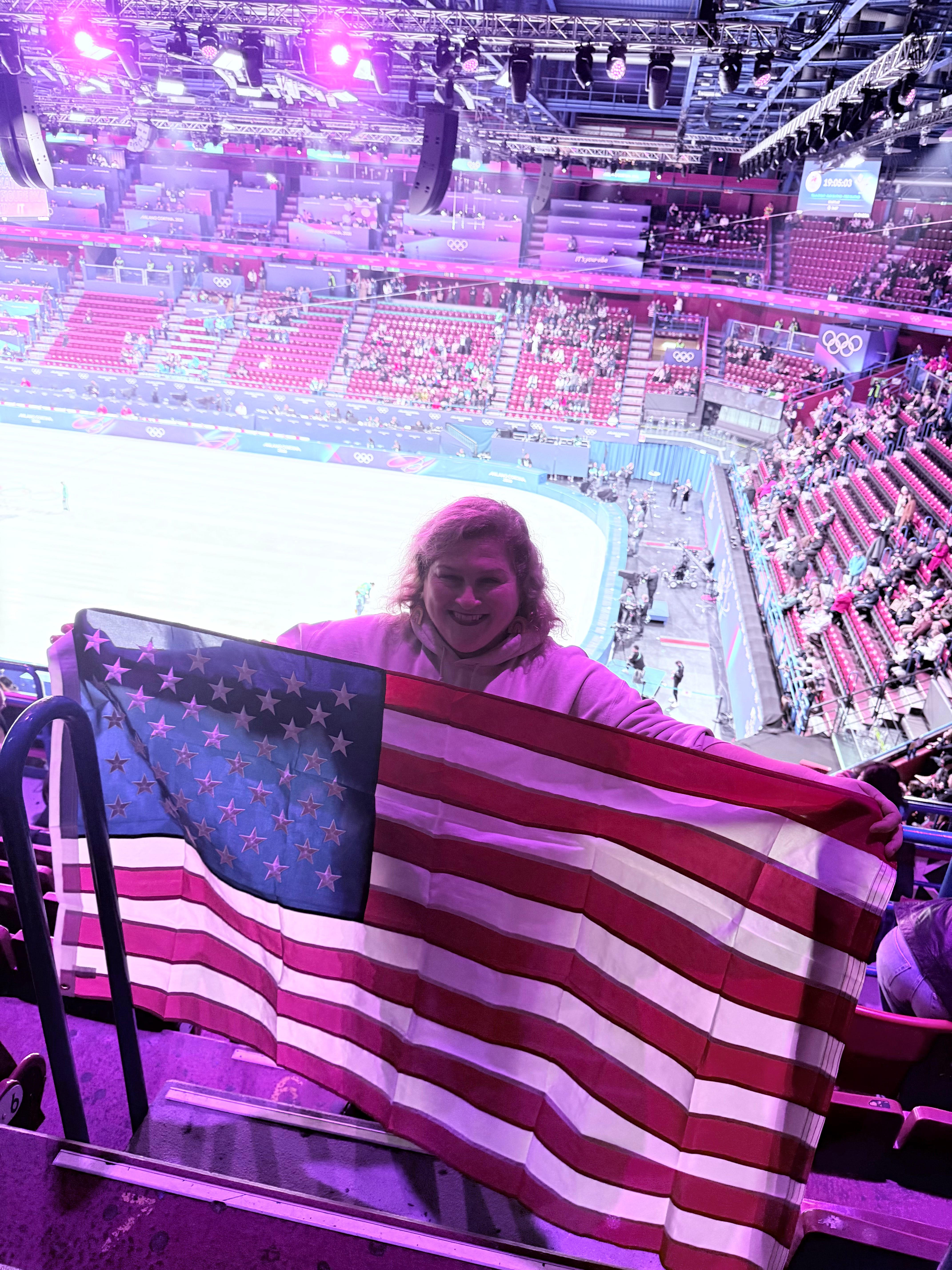
Like figure skating’s conversations about the need to balance technical prowess with artistry, the helping professions also have discussions about the art and science behind a certain approach to therapy. Don’t get me wrong, I can love my technique too. As an EMDR Therapy trainer I pride myself on teaching solid technique, yet I also make mention (especially in more advanced training and consultations) of when the technique needs modification. During the team event final in Milan, I told the person sitting next to me that I admire clean skating more than anything and believe that when all other factors are close to equal, the programs skated cleanly should win. And I take umbrage with how figure skating judges can punish the solid technicians for not being classically artistic enough. Yes, I still hold a grudge that Canada’s Elvis Stojko didn’t win the gold at the 1994 Olympics. For me, his artistry was in being himself, bringing in his martial arts interests into his skating programs.
As someone who believes that therapy is more of an art than a science, I believe that the field’s insistence on scientific credibility to ensure our legitimacy (and the funding that comes with it in this capitalistic hellscape in which we find ourselves) has snuffed out the art. Especially the appreciation that the best art flows from authenticity. I shared via my Substack writing not too long ago, I no longer believe that I can educate in such a system. In my piece Closing a Chapter on EMDR, I share the rationale behind my decision to no longer offer basic training in the clinical modality where I made my biggest mark, eye movement desensitization and reprocessing (EMDR) Therapy. A major reason behind my decision is seeing how the EMDR International Association (EMDRIA) has changed the training standards since the pandemic in a way that they believe assures for higher standards. Some of these moves seem designed to better play the political game of modern psychotherapy and EMDR training. In my view, they are focusing on the wrong things.
Much of this will come across like I am picking on EMDRIA. Please note that I retain a level of respect for this organization to which I have belonged for 20 years. Moreover, I believe that the problems I’m highlighting with EMDRIA are not unique to EMDR Therapy, they are indicative of what is going on in the field at large. As EMDR Therapy has grown in popularity, a phenomenon made possible not just by clinical research but also through the testimonials of real people attesting to its power, it seems that so many EMDR therapists want to get in on the action of training it. And inevitably cashing in on its success as an approach to psychotherapy. Because the creator of EMDR Therapy, Dr. Francine Shapiro (1948-2019) released much of her hold on EMDR by allowing the independent accrediting body of the EMDR International Association (founded in 1995) and other regional organizations to be created, it has opened up the door for everyone who believes that they could be an EMDR trainer to at least apply for it. And with the growth has come more political battles about which bodies and training organizations are doing it best. The popularity of online training, something we never thought was possible in the first 30 years of EMDR Therapy, skyrocketed during the pandemic-induced lockdown. There is an interest in offering training in EMDR Therapy unlike I’ve ever seen in the twenty years that I’ve been involved with EMDR.
Based on these realities, coupled with the realities of capitalism, I can see the need for standards. I really can. Yet instead of vetting potential trainers on their own emotional intelligence or lived experience with EMDR Therapy as a therapy participant, we are micromanaging every aspect of how they teach and making them account for every decision on every page of their manual. We are letting trainers through who still have a tendency to pathologize dissociation, neurodiversity, and yes, even diversity in sexuality and gender expression. At one conference my jaw almost hit the floor when an EMDRIA-approved trainer I spoke to called Riley, the protagonist of the Inside Out films, “neurotic.” The whole purpose of that film franchise is to normalize emotions and having parts and aspects of experience, and it concerned me that a trainer couldn’t identify this reality. Nor did they seem interested in discussing it.
As someone who started as a teacher and remains more of a teacher than a therapist, I applaud EMDRIA’s efforts to focus more on pedagogy. Yet the key point of pedagogy that they seem to be missing is that you have to allow that room to breathe in order to meet individual learners where they are at, especially in large group training. Micromanaging the pedagogy, especially when the people micromanaging it are not EMDR therapists themselves, is counterintuitive to training any clinical modality with a level of emotional and somatic intelligence. You can’t inundate trainers with objectives and standards that they have to meet, standards that overwhelm the general time prescribed for the average clinician to take off for a basic training, and expect us to be emotionally attuned and dynamic teachers. I’ve found a way to work with it all yet after every basic training I teach, I’m inevitably filled with an exhausted sense of, “This is not how I want to teach.”
In Sandra Bezic’s words, I need to breathe, and I need to allow my students to do that too.
In the figure skating discipline of ice dance, the final segment is called the free dance. As an older casual watcher of figure skating, you may remember Jayne Torvill and Christopher Dean’s Bolero from the 1984 Olympics in Sarajevo as the free dance of all time, scoring straight 6.0s across the board. Yet in modern ice dancing, there is nothing free about the free dance. Lifts are timed. Elements are largely prescribed. And there is minutiae in the rules that makes it challenging for folks to offer something that compelled audiences quite like Bolero did. Moreover, ice dancing still remains the discipline shrouded in the highest levels of shadiness around how skaters and their elements are judged. The coaches under whom you skate are still reported to have influence in how the judging goes down. That is what needs to be investigated and reformed, in my opinion. Yet that is a darkness that we as people and as institutions don’t want to look at. It is easier to choke people with rules and standards instead.
The dark realities of the clinical professions in which I work and still fiercely love is that we allow people to teach who are not fully and emotionally connected to the material, just because they can pass a test or play the academic-institutional game. We dismiss the nuance of lived experience for the certainty of what the rules, protocols, and ten easy steps tell us to do. We allow discrimination to continue based on who or how a person loves or on how they show up in the world. And we abandon the artistic, Indigenous legacy of our work in favor of the credibility that science seemingly provides.
We are, quite simply, focusing on the wrong things.