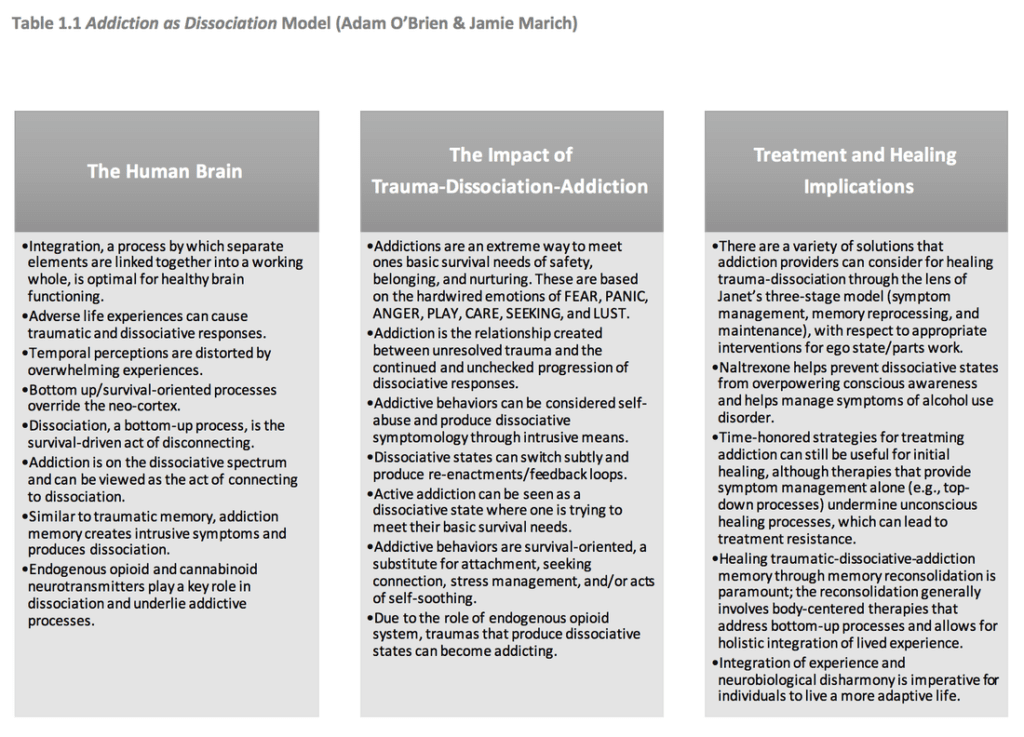
Addiction as Dissociation Model

Table 1.1: Addiction as Dissociation Model

Share This Post

​Addiction is a dissociative response. Sounds like common sense, right? For many years we’ve operated in our practices fueled by this assumption. As individuals in personal recovery, the link between unhealed trauma/dissociation and addiction has been blatantly obvious. Even when we share our work with people on developing this new model of Addiction as Dissociation, we are met with a great deal of, “Well yeah, obviously.”

Yet the reality is that no contention in the literature has been directly made addressing this link… until now. The connection between unhealed trauma and addiction has been well asserted, with giants in the field like Gabor Mate, Bessel van der Kolk, and many others speaking to this link. What about dissociation? Dissociation comes from the Latin word meaning to sever. When an experience or a moment becomes too overwhelming for a person’s system to handle, we have a tendency to sever from that present moment, or from our core self. Dissociation is a very normal response of the brainstem that can activate when we are met with overwhelming distress. Dissociation can be adaptive (e.g., spiritual pursuits, proper use of guided imagery, daydreaming, the Netflix binge when you need to decompress) or maladaptive. When the manifestations of dissociation are maladaptive, they are likely to cause functional impairment. The various signs and symptoms of addictive responses can be examples of this phenomenon. Moreover, maladaptive manifestations of dissociation result when traumatic experiences or stressful events have not been processed and reconsolidated.

Both of us have been working very hard in 2019 to scour the literature and create a model that we are now calling Addiction as Dissociation. Regardless of your adopted stance on addiction (e.g., a disease, a response to trauma) or whether you even like the word (i.e., you may prefer behavioral compulsivity), this model will likely be relevant to your practice. We’ve prepared a table version of the model that you can examine in this blog. You are welcome to share it and we also value your comments on what resonates and what may still need refinement. Our scholarly paper that fully supports the contentions and flow of the model is currently under review and we will keep you posted about the more formal debut of this model to the world.


5 Responses

Leave a Reply

Your email address will not be published. Required fields are marked *

Subscribe To Our Newsletter

Get updates and learn from the best

More To Explore

Close-up of a person in a dark suit jacket pointing directly at the camera, with the finger in sharp focus and the face out of the frame and blurred in the background.

Beware the Healing Police

“We need to teach people more skills for regulating their nervous systems in these troubled times,” a colleague shared during a recent meeting. She offered

Illustrated scene of three smiling, middle-aged women dressed as friendly superheroes standing in a warm, glowing backdrop filled with hearts. Each wears a cape and emblem and holds a notebook or clipboard, suggesting care or guidance. In the foreground, a person with curly red hair faces them with hands over their chest in a gesture of gratitude. Framed photos of caring moments sit nearby, reinforcing a theme of support, love, and appreciation.

To “The Justice League”- Thank You

Since beginning my therapeutic journey in 2008, I have made it a practice—without fail—to say“Thank you” as I walk out of every session. On the