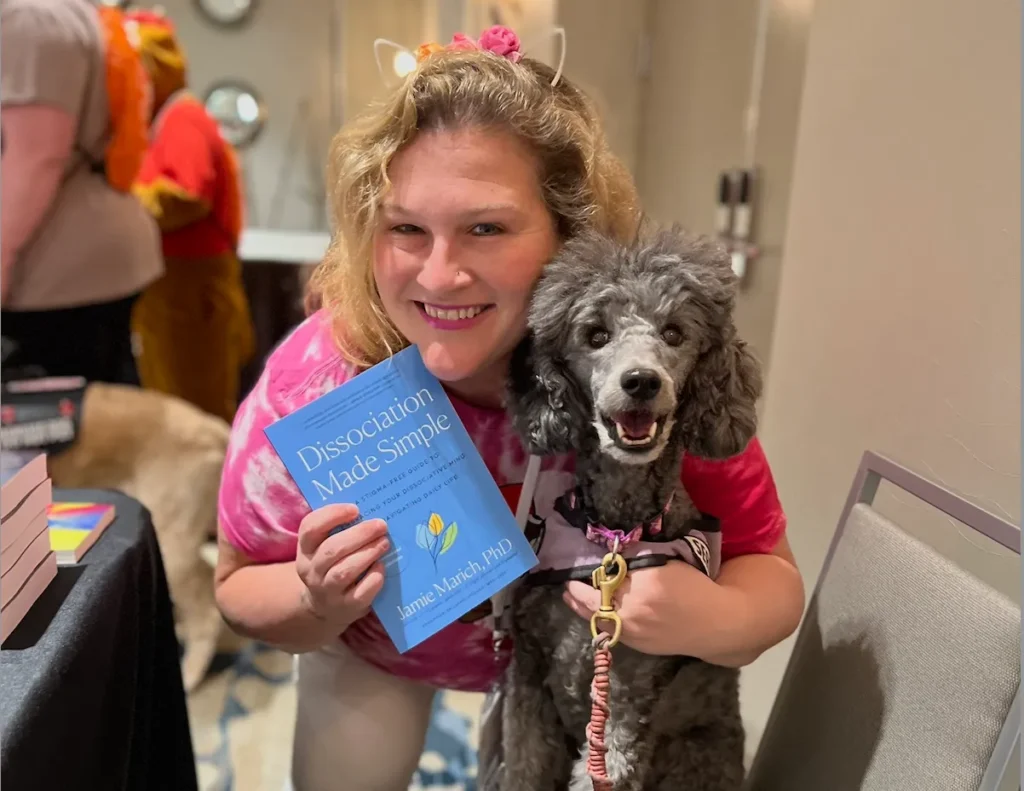
When I began drafting Dissociation Made Simple at the beginning of 2022, I thought the phrase dissociation is not a dirty word might be a better title for the book. After analyzing over 60 interviews of contributors who freely shared the wisdom of their lived experiences with me, this core theme (one of six from the interviews) emerged: While dissociation, or specifically the traumatic roots of it, can cause problems in daily living or in societal systems—problems that need to be addressed—dissociation is the skill that has allowed so many of us to survive and, in many ways, to thrive (p.3)
As a quick review, dissociation simply means to sever or to divide. Human beings can do it in a variety of ways (e.g., daydreaming, zoning out, putting ourselves somewhere else) when the present moment is painful, traumatic, stressful, or downright boring. For some of us, the natural parts and ego states that we all have as humans can become more distinctively severed or divided as responses to trauma. Dissociation can be so many things, all at once. It can be a coping skill, a survival mechanism, and an impetus for great creativity and thriving, especially when it is appreciated as such.
While my publisher shot the title change down, they agreed it was a good idea to name the introductory chapter Dissociation is Not a Dirty Word. They also had bookmarks and stickers printed for me, declaring this anthem to help me promote the book, released in January 2023. The phrase got some attention in a piece from Maggie Jones that dropped in The New York Times Magazine on January 30, 2026 called What It’s Like to Live With One of Psychiatry’s Most Misunderstood Diagnoses. Although my work is mentioned in the piece in what seems like an afterthought, I am grateful that it was indeed mentioned in an article that gave the primary microphone to more academic voices. Now seems like a good time to revisit the phrase and what it means to me personally, especially when so much fear about dissociation still abounds in clinical and academic circles.
The fear that I continued to observe amongst professionals and academics, even in trauma spaces, was the primary motivating factor in my coming out. I had to speak up after years of holding it in. On one side, we have the professional camp who doesn’t believe that dissociative disorders are “real.” To me, such denial proves how dissociated even smart people can be when they are uncomfortable with facing trauma. And on the other side, we have academics who have devoted their lives to validating dissociation. So much of their focus seems to be on proving the doubters with science and evidence. We need these scientists and these researchers. I applaud their work. I cite their work, and their minds are valuable in fighting the skeptics of the world. I wouldn’t be where I am today as a working professional who is able to speak so freely without them.
Yet it was clear from the early days of my career that I would never really fit into the academy and stay mentally well. In 1996-1997, I declared my first undergraduate major as Pre-Med and started classes on that track. While I knew I could do it academically, in living through the darkest days of my own mental health struggles, my soul prevented me from studying something that felt so removed from human emotion. So I shifted to the humanities. In 2006, I quite literally ran away from the first traditional Ph.D. program I attended, knowing that my mind and the way it worked would not be safe there. I declared in You Lied to Me About God: A Memoir (2024), which focused on my experiences in high demand religions, that science and academia was the biggest cult I ever escaped. So I offer you that as a disclosure of both my bias and an introduction of my perspective.
In my opinion, academics, many clinicians, and even some of the spiritual writers I otherwise admire are not connected to what it means to embrace dissociation without shame. They seem to focus more on the pathology of dissociation and living with parts; less on the creativity that it can engender. Dissociation can also serve as a gentle cushion for people who are trying to live through the socio-political climate that we find ourselves in right now. So much focus is placed on how dissociation keeps us from being present. In my reality, the gifts I’ve retained from having a dissociative disorder help me to be more present through these times without destroying myself. Through their teaching and scholarship, many scholars have inevitably influenced scores of clinicians practicing today, causing them to approach dissociative responses with a caution that I find problematic. For the record, clinically-appropriate caution and prudence in conducting practice with people who dissociate is necessary. I teach that too. Grounding is important, but not to the point of stifling us. Dissociation is more than what you can ever learn in a scientific textbook. We must also look at it with the lens of the arts, humanities, and the varieties of lived experience.
I decided to fully come out as a system in 2018 when I was well-established as an EMDR Therapy trainer and, at the time, the author of about 6 published books. I received a professional diagnosis of what is now called Otherwise Specified Dissociative Disorder (OSDD) in 2004 and had two years of intensive therapy. For a while, I lived believing that I was “integrated” because I no longer had the major symptoms that caused me to struggle in the first place. I wonder now if my parts didn’t seem to be a factor in the years from 2006-2016 because it was in my best interest to show others—my first husband (who is a Medical Doctor), the field in which I was practicing–that I was all better. While my first trauma therapist never told me not to tell others about my diagnosis or having a system, the implicit message that I got as a baby trauma therapist was that having a dissociative diagnosis was one of the worst that you could have. And don’t even think about breathing a word about it in professional spaces! Meanwhile, I was sitting at conferences trying to educate myself on dissociation from clinically cold and academic voices. I would often fawn over them, full of my internalized ableism, thanking them for teaching me so much. Yet in reality I would sit back during their talks, thinking, “This was not my experience of dissociation or systems at all. And they are making it so much harder than it needs to be.”
Any chance I had to stay seemingly integrated, a time in my life that I now just describe as being zipped in, went out the window during the year that was 2016. Not only did my nation and many people I love elect a leader who reminded me of several abusers, my second marriage began to traumatically crumble. During a relapse in some symptoms that got in the way of my life, I re-entered intensive trauma therapy. My dissociative disorder was once again confirmed by taking the frustrating clinical assessment that was the MID-218. The approach my new therapist and I decided to take was different, even though I was now “Dr. Jamie Marich” and knew so much. This approach involved learning to accept my internal system of parts just as they were/are and not shaming them away again. We’d lived with so much shame as the result of our abuses and years of hiding our sexuality. Why would we continue to embrace a healing path that involved us hiding who we really are, parts and all?
In the years since coming out, there are those who would say I am less healed and more reactive than I was before. Not regulated enough to have a platform. If speaking up against injustices towards people who dissociate makes me less healed in your eyes, okay. I’m in good company with other troublemakers. The people who say those things don’t really know me. Being authentically myself/ourselves in the years after that marriage ended has ushered in the greatest periods of wellness and happiness that we have ever experienced. And even though we are still learning to navigate some bumps that life puts on the road, we celebrate what it means to live with authenticity.
The outcome of learning to speak my truth and dance with the consequences has taken me to some pretty incredible places. Life these days means placing increasingly less emphasis on work and more time on my own health and care; more time for my family and loved ones; more time for pursuing my spiritual interests and attempting to make a difference for my communities in this toxic political climate. I am working to build a life where I may never have to attend a conference again! I am actively deconstructing what it means to be a therapist in a field that, I believe, is largely failing people. I write about my process here on Substack, where I can speak freely and without censorship. I am honored that many of you are finding my ideas useful. I am grateful that people and systems have considered my coming out to be something that inspired them. For me, it was learning to finally practice what I’d been preaching: living an authentic and truthful life as the ultimate healing power.
The truth is that my parts have always cooperated with each other, and their communication helps me to show up as the best version of myself in all the roles that I occupy. Now that I don’t try to hide them, they are able to fully spread their wings for me. For a while I thought this approach to healing might be too radical. Yet it is not unlike the approach to addiction recovery that I first learned through 12 Step recovery. While that approach doesn’t work for everyone, in the 23 years that I’ve been sober it’s made great sense to never see myself as having “recovered” or looking at my addiction as a thing of the past. My system and I will always be recovering, a work in progress/process. I am no more ashamed of being a person in long-term recovery from addiction than I am being a person with a system of parts who has dissociated to survive terrible things and in so doing, learned how to find my true self/selves in the process.
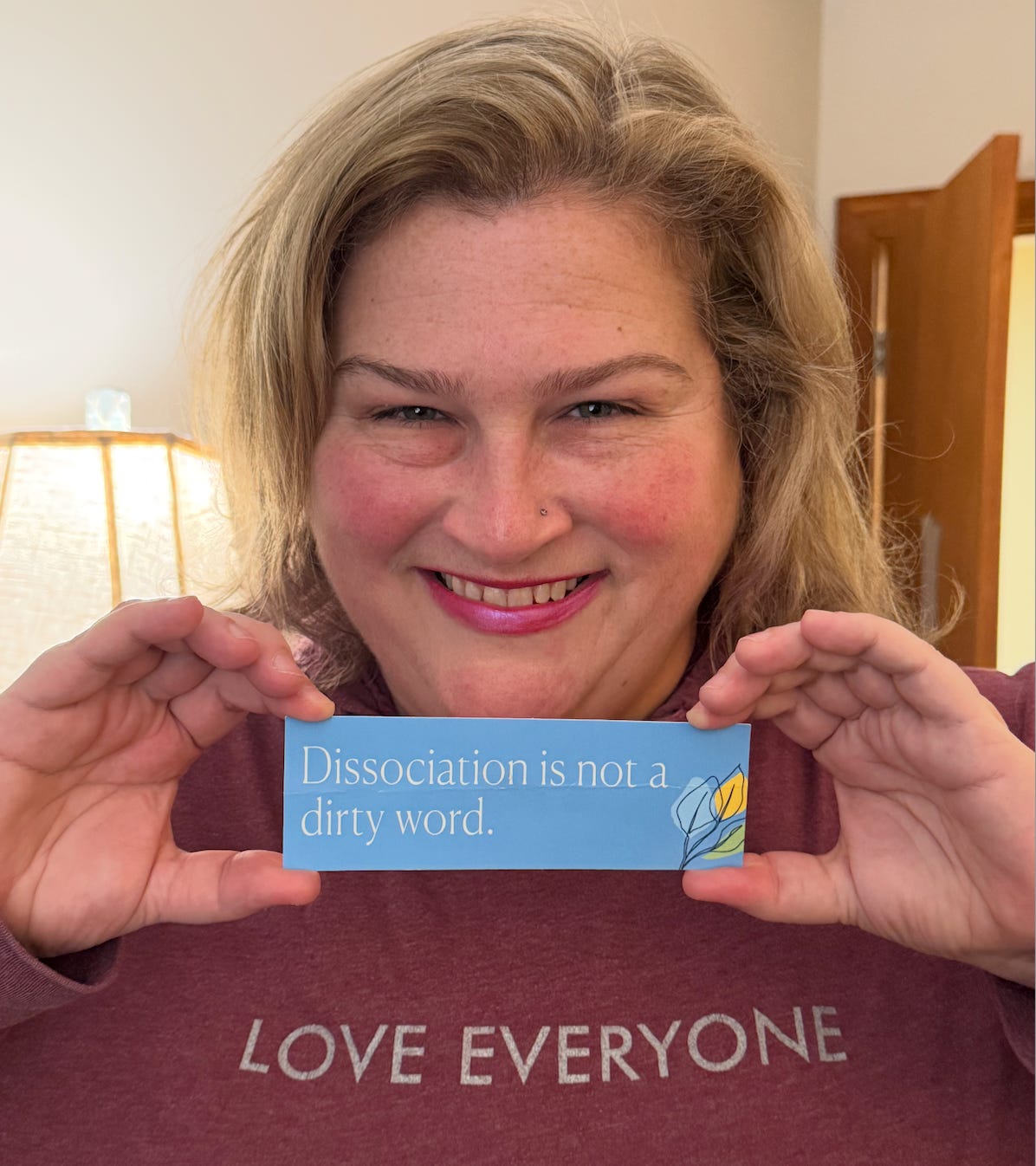
Maggie Jones first picked up my bookmark at the Healing Together Conference three years ago. As I look back on the phrase Dissociation is Not A Dirty Word with some perspective, I not only stand by it, I celebrate it. After years of taking on other people’s shame, the pride approach has helped me to heal more deeply than I ever thought possible. It also helps me to take inventory and be able to see where we may be getting in our own way in terms of our healing and recovery. A pride approach does not mean constantly using parts or their responses as an excuse or not taking a look at where your behaviors (and/or your parts’ responses) may be harming others. The pride approach of Dissociation is Not a Dirty Word embraces a neutrality and a sense of both/and that, I believe, is ultimately nourishing for people who experience trauma-based dissociation.
Once more for the people in the back:
While dissociation, or specifically the traumatic roots of it, can cause problems in daily living or in societal systems—problems that need to be addressed—dissociation is the skill that has allowed so many of us to survive and, in many ways, to thrive.